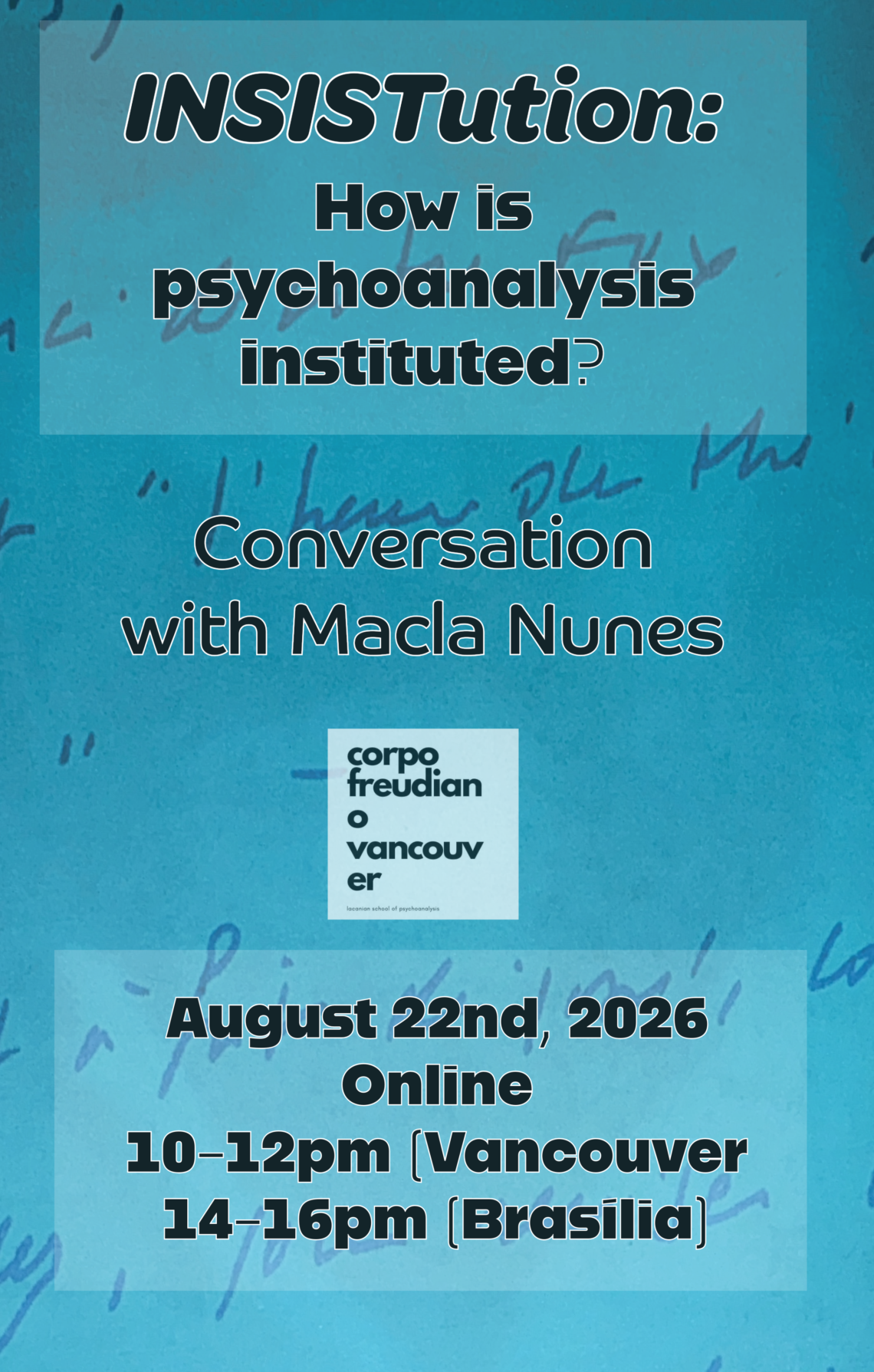
INSISTution – How is psychoanalysis instituted?
Conversation with Macla Nunes*
Free Event for Corpo Freudiano Members
For all others, CFV suggests a DONATION of $25-50 to help us keep hosting events like this one.
Please register HERE. EVENT ONLINE
August 22, 2026 – 10AM to 12PM (Vancouver Time)
The history of analytic institutions reveals that the psychoanalytic community is not immune to the compulsion of regulation and dogmatism. Sigmund Freud, when discovering the unconscious and inventing psychoanalysis, also became a “leader of a movement” who was always critical and reticent toward administrative and organizational rules. But this did not prevent the system of psychoanalytic formation, at its base, from witnessing a rejection of the specifically analytical, inventive and desiring dimensions of analysis. Dissatisfied with this escaping of analysts from the psychoanalytical field, Jacques Lacan does not break with the classical structure of training – personal analysis, supervision and theoretical study – but tries to break with the authoritarian and dogmatic logic that prevailed in existing societies, proposing new ways of instituting oneself. Turning one’s gaze towards the history of psychoanalysis to understand this question, which has been central, neuralgic, and recurrent since its foundation, is a task that convoke us. We seek to map solutions to these crucial problems, which are reflected to this day in analytic societies, situating them mainly in the thought of the French writer, playwright, and psychoanalyst Alain Didier-Weill, a disciple and student of Lacan. From a retaking of the Freudian and Lacanian paths, Didier-Weill’s work seems to present unprecedented proposals that are more coherent with the principles of psychoanalysis by addressing challenges of the institutional experience and pointing out possible routes of reinvention that do not exclude, from the institution, the dimension of insistence proper to the unconscious and the movement of desire: “Insistution“.
Suggested Bibliography:
Nunes, Macla. “Como se Institui a Psicanálise? Transmissão, Insistuição, Reinvenção.” (2024).
Balint, Michael. “À propos du système de formation psychanalytique.” In: Amour primaire et technique psychanalytique.Paris: Payot, 1972.
Bernfeld, Siegfried. “On Psychoanalytical Training,” The Psychoanalytic Quarterly, vol. 31, no. 4, New York, 1962, pp. 453-82
Benveniste, Daniel and Adler, Nathan. “Conversations with Clinicians”. In Fort Da: The Journal of the Northern California Society for Psychoanalytic Psychology Vol. XVIII, NO.1, Spring 2012.
*Macla Nunes: Musician, psychoanalyst. Graduated in Sacred Music/Bachelor in Singing and Psychology. Master in Psychoanalytic Theory (UFRJ). PhD in Research and Clinical Psychoanalysis (UERJ). She works as a psychologist/psychoanalyst at the School of Medicine and Surgery at UNIRIO. Analyst Member of the Corpo Freudiano, School of Psychoanalysis, Rio de Janeiro Section. Author of “How is psychoanalysis instituted? Transmission, Insistuition, Reinvention” (2024).
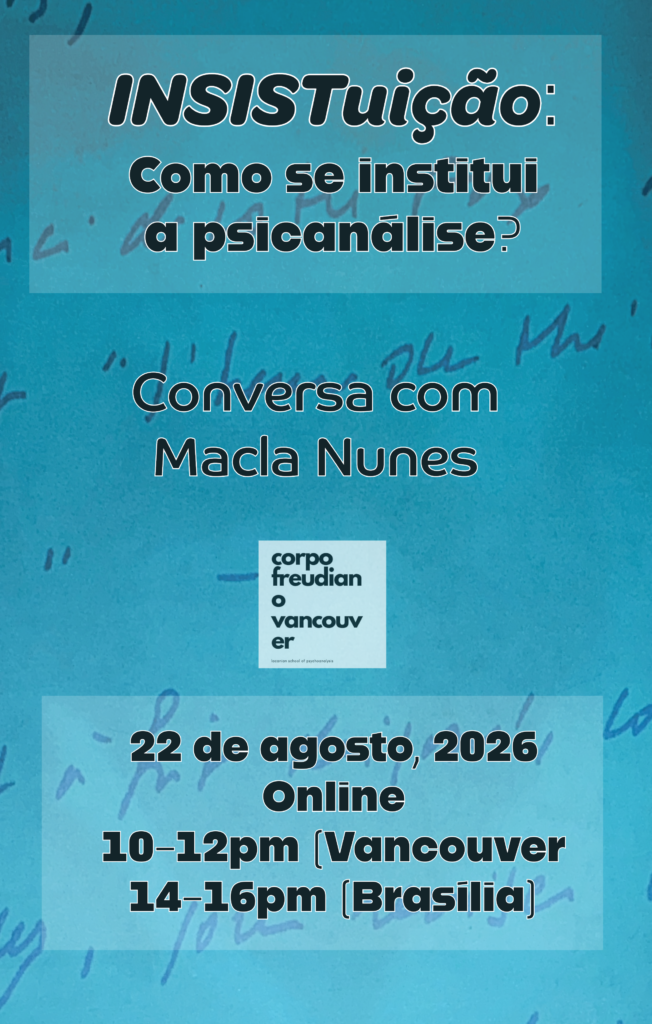
INSISTuição – Como se institui a psicanálise?
Conversa com Macla Nunes*
22 de Agosto de 2026 – 14PM to 16PM (Hora de Brasília)
Evento Gratuito para Membros do Corpo Freudiano –
Para participar, inscreva-se AQUI. EVENTO ONLINE
Para quem não é membro, CFV sugere uma DOAÇÃO de $25-50 por pessoa para que possamos seguir realizando eventos como este. Obrigadx!
A história das instituições analíticas revela que a comunidade psicanalítica não está imune à compulsão à regulamentação e ao dogmatismo. Sigmund Freud, ao descobrir o inconsciente e inventar a psicanálise, torna-se também um “chefe de movimento” sempre crítico e reticente em relação às regras administrativas e organizacionais. Mas isso não impediu que o sistema de formação psicanalítica, em sua base, tenha testemunhado uma rejeição das dimensões especificamente analítica, inventiva e desejante da análise. Inconformado com essa escapada dos analistas para fora do campo da psicanálise, Jacques Lacan não rompe com a estrutura clássica da formação – análise pessoal, supervisão e estudo teórico –, mas tenta romper com a lógica autoritária e dogmática que vigorava nas sociedades existentes, propondo novos modos de se instituir. Lançar um olhar para a história da psicanálise buscando compreender essa questão que é central, nevrálgica e recorrente desde a sua fundação é uma tarefa que nos convoca. Buscamos mapear saídas para esses problemas cruciais, que se refletem até hoje nas sociedades analíticas, situando-as, principalmente, no pensamento do escritor, dramaturgo e psicanalista francês Alain Didier-Weill, discípulo e aluno de Lacan. A partir de uma retomada dos percursos freudiano e lacaniano, o trabalho de Didier-Weill parece apresentar propostas inéditas e mais coerentes com os princípios da psicanálise ao abordar desafios da experiência institucional e apontar caminhos possíveis de reinvenção que não excluem, da instituição, a dimensão da insistência própria ao inconsciente e ao movimento do desejo: “Insistuição”.
Bibliografia Sugerida:
Nunes, Macla. “Como se institui a psicanálise? Transmissão, Insistuição, Reinvenção” (2024).
Balint, Michael. “À propôs du système de formation psychanalytique.” In: Amour primaire et technique psychanalytique.Paris: Payot, 1972.
Bernfeld, Siegfried. “On Psychoanalytical Training”, The Psychoanalytic Quarterly, vol. 31, n. 4, New York, 1962, p. 453-82
Benveniste, Daniel and Adler, Nathan. Conversations with Clinicians. In Fort Da: The Journal of the Northern California Society for Psychoanalytic Psychology Vol. XVIII, NO.1, Spring 2012.
*Macla Nunes: Musicista, psicanalista. Graduada em Música Sacra/Bacharel em Canto e Psicologia. Mestre em Teoria Psicanalítica (UFRJ). Doutora em Pesquisa e Clínica em Psicanálise (UERJ). Atua como psicóloga/psicanalista na Escola de Medicina e Cirurgia da UNIRIO. Analista Membro do Corpo Freudiano Escola de Psicanálise Seção Rio de Janeiro. Autora de “Como se institui a psicanálise? Transmissão, Insistuição, Reinvenção” (2024).