60 Years of Lacan’s Écrits
A Celebration by Corpo Freudiano
On November 15, 1966, the French publisher Seuil published a volume of more than 900 pages entitled Écrits. From that moment onwards—and very quickly—its author, named Jacques Lacan, would become Lacan, the most important psychoanalyst in history, after the creation of psychoanalysis by Sigmund Freud.
The publication of the volume had been proposed three years earlier by the renowned editor François Wahl, who dedicated himself, body and soul, to producing the edition. It was the first work to be published by Lacan, whose oral seminars had begun in the 1950s, and it brought together articles that had appeared in various specialized journals over time, as well as some that were still unpublished, such as the conference “The Signification of the Phallus.”
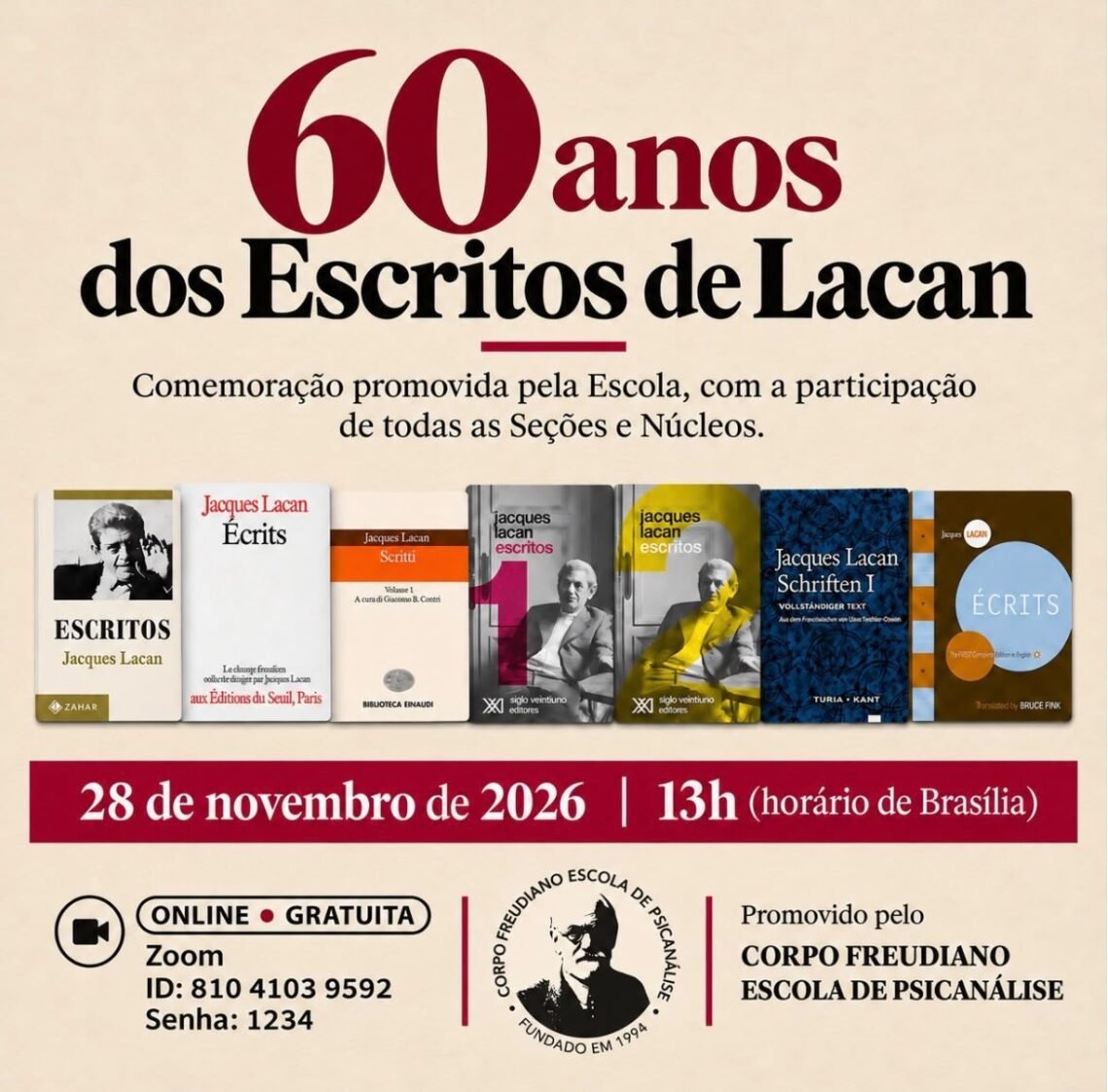
In Brazil, Écrits were initially published in a volume that brought together a brief selection of texts from the original volume, translated in 1978 by the professor and linguist Inês Oseki-Depré, in contact with Lacan, and published by Perspectiva. The complete translation of the original volume appeared 20 years later, in 1998, from the publisher Jorge Zahar, in the collection Campo Freudiano no Brasil, translated by Vera Ribeiro. In the Anglophone world, the Écrits, which kept their French name, were reunited only in 2006 in Bruce Fink’s translation, after circulating in fragments for decades.
In a note written in the introduction to the “Classified Index of the Major Concepts,” prepared by Jacques-Alain Miller at the request of Wahl, Lacan states about the book that it is “a work that introduces less than it questions.”[1] One can read in this statement the echo of the title of a work Lacan had not published, Mise en question du psychanalyste (Questioning of the Psychoanalyst), which never came to light. It would be an original work and not a compilation of texts.
The texts of the Écrits assimilate a knowledge developed over a period of thirty years, between the years 1936 and 1966. Elisabeth Roudinesco reminds us that Lacan, with his passion for oral transmission through his seminars, had a great ambivalence towards the publication of his Écrits, which on several occasions he called poubellication, a porte-manteau that assimilates garbage with publication.[2]
Writings that question – this may well be a simple and summary definition of the book, since questioning abounds on every page. But, in the end, Lacan’s Écrits are, in fact, a questioning of the psychoanalyst—of his discourse, of his knowledge, of his place, of his desire, of his resistance—on which the existence of psychoanalysis depends.
Écrits brings together the essays that constitute the basis of Lacanian thought in his movement to return to Freud, which he defined as a return to the meaning of Freud’s work. Lacan’s magnum opus is a challenging trajectory of style, a “type of infinite text”[3] and also “a curious mixture of penetration, poetry and voluntary obscurity,”[4] which forces the reader to navigate the text’s difficulties with courage.
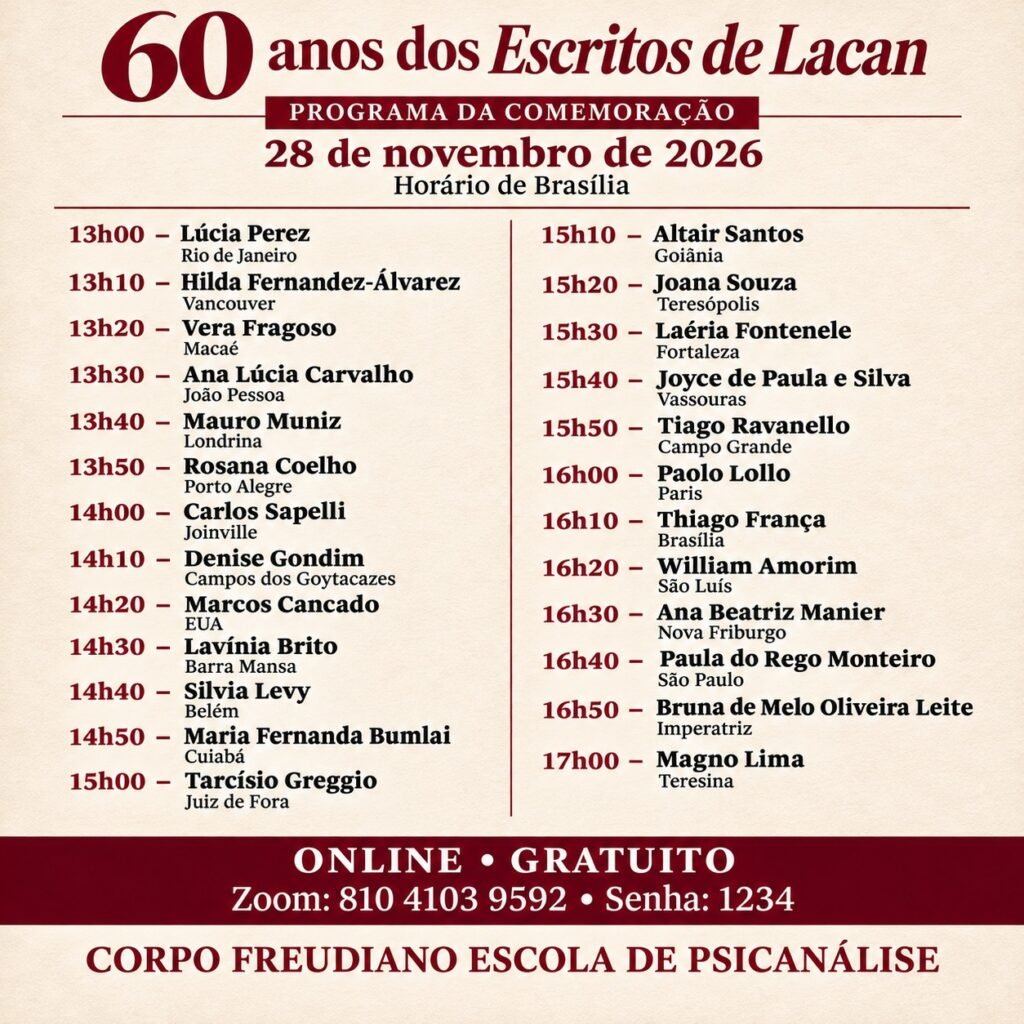
Celebrating the 60th anniversary of the publication of the Écrits, Corpo Freudiano School of Psychoanalysis—which completed 32 years of existence this year – will host, on Saturday, November 28, 2026, at 1:00 pm, online via Zoom, a meeting in which representatives of its Sections and Nuclei will make free and brief interventions on this major work of contemporary psychoanalysis. Tod@s are invited to the meeting, which will last one afternoon. There will be no debates or discussions, only tribute testimonies.
Hilda Fernández-Alvarez / Marco Antonio Coutinho Jorge
Translated from the Portuguese by Désirée Jung
Edited and revised by Juan Luis de La Mora
[1] J. Lacan. Escritos. Rio de Janeiro: Jorge Zahar, 1998, p.908.
[2] E. Roudinesco. Lacan: Esbozo de una vida, historia de un sistema de pensamiento. Mexico: FCE, 1994, p.467.
[3] D. Hook, C. Neill & S. Vanheule. “Reading Lacan’s Écrits: From the Freudian Thing” to “Remarks on Daniel Lagache”. London/New York: Routledge, p.4
[4] A. Wilden. Speech and Language in Psychoanalysis: Jacques Lacan. Baltimore/London, Johns Hopkins University Press, 1968, p.311.